
 Continue with onX Maps
 Sign in with Facebook








Dynamic personal tether line without knots, seams, or splices (ducks for cover).


|
|
A recent thread about the Kong Slide, Petzl Connect Adjust, etc, got me wondering about making a dynamic tether line for them that would essentially be a piece of kernmantle rope with a girth-hitch loop built-in, rather than sewn in, tied, or spliced (splicing kernmantle is dodgy at best). There are double-braid nylon ropes that can be spliced, but they're more boaty (loose cover, and hard to splice a short piece). So I started the new year with this:  It begins with a selvagee of nylon cord inside a polyester/Technora cover (kind of like the Blue Ice eye-to-eye runners). The inward parts aren't spliced: rather, each strand begins at the bitter end, proceeds around the eye, and returns to where it began. There are eight bits of cord, making a total of 16 in the body of the rope, which measures 10mm. The could be dropped one at a time to make it skinnier: 7 lengths would make 14; 6: 12, etc. The theoretical load of this one would be 3,600lbs, or 16kN (16 bits of 225-lb cord), but much testing would be required to establish an actual rating.  Above is a pic of what the core looks like (a much shorter piece of core for illustrative purposes). It's fiddly to put together, and much longer than tether length would be really hard to make.  Now it's pictured with the Slide (I find 8mm far better with the slide: it just runs better) and a Tibloc for scale. If this was a product, would the seamless and knotless girth loop be desirable? While I have no desire or intention of going into production with this--I prefer static tethers, or at least don't see a huge value in stretchy ones--it might be good to have in the back pocket. Happy New Year, all! |

|
How much force reduction does a meter of dynamic rope actually provide? I am sure it is better than a steel cable, but is there any proven, objective, difference between a meter of dynamic versus a meter of static rope? I would bet the difference is insignificant. EDIT: Actually, most of the time my tether length is around 0.5 meters. |
|
|
The obligatory #justusetherope comment. |
|
|
Mike Gibsonwrote: It is very significant and there has been good testing. A FF2 on rope of any length will hurt but will be ok. A FF2 on static material of say four feet produces gear breaking forces. The impact from the fall probably won't kill you but the fall after your PAS breaks will. We're talking the difference between 7-9kN and 30kN+ |
|
|
Ricky Harlinewrote: Would you have links or references to support your numbers? I want to see a side-by-side comparison of 2 feet of dynamic vs static. No theories, calculators, or estimators please. |
|
|
DMM drop test results tldr: difference in force is roughly 2x static v dynamic; regardless of material, slack in the system is bad; knots in dyneema are bad; best to use the rope https://m.youtube.com/watch?v=SY12o2FxjpU |
|
|
Mike Gibsonwrote: Just look at How Not 2's numbers when they did small, static whippers which are a dramatically better case than a FF2. Here's the data they got: 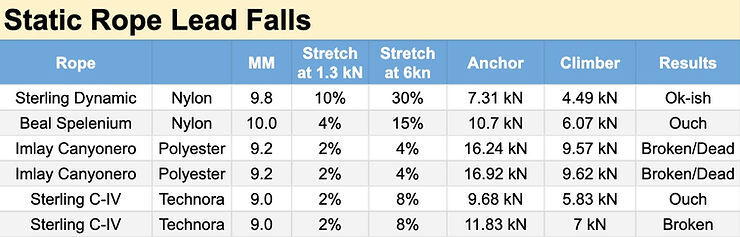 So a dramatically better scenario would cause these static ropes to break. You want to up the forces dramatically from here. Also look at that DMM video.
"I have a very specific test case I want to see that no one has done, I don't want to deduce conclusions from the data that are available, and I also don't want to do any work myself." OK good luck with that |
|
|
 |
|
|
rock climbing wrote: Yes, thinner is better for weight/bulk reduction, but people have to get used to how things look. A lot of people, seeing two otherwise identical slings, one black and one any other color, will assume the black one is stronger. A lot of it is optics. I feel fine rapping on one strand of 6mm Dyneema-cored rope, but some don't. As for the 8-core section being weaker, that's one of the imponderable mysteries of loop making: the far end of the loop is the same strength as the rest. An engineer explained it once in a way I kind of understood, but I can't replicate his explanation. If it weren't so, the loops would always break at the back end of the pin/biner/shackle they were being pulled with. But that's not the usual failure mode: it's somewhere in the body of the sling. In the slide, I'd guess the break would come where the rope bends sharpest. |

|
 |
|
|
I just love these complex solutions to simple problems that really don't exist. There's really no need for things like the Kong Slide or Petzl Connect Adjust. |
|
|
TThurmanwrote: Different diameters would just be a function of a different amount of passes of core twine coupled with a properly-sized cover. You can "milk" a cover down a certain extent, or fatten it up somewhat, but ideally all the picks are crossing each other at right angles. I made that sample as an academic exercise more than anything--can a knotless and seamless dynamic tether be made? But I don't see much value in such things: when I need to work-position I prefer a static line in my slide (I made a SK99-cored eye to eye Seamless strop with a poly/technora cover. Static gear is usually stronger, slimmer, and more durable), and I find my chain o' loops daisy so much more convenient that I haven't used the slide in a while. For leisure climbing, I find that being tied to a 200-foot piece of rope is all I need. Clove hitches are dead simple to adjust at a belay. Still, for those who do use Adjusts, etc, this could reduce bulk nicely. |
|
|
Marc801 Cwrote: No, but such gadgets add convenience and often save time. Royal Robbins' book Rockcraft complains about how climbers are too reliant on widgets and gizmos like belay devices, and tbh that's how comments like these come across to me. What you strictly need and what makes climbing convenient and enjoyable are different things. |
|
|
The issue with these tests Ricky is you are not a giant steel weight, nor are you taking FF2 falls off a drop tower, the theory simply doesn't line up with reality. We can see this in numerous times of people taking daisy falls onto skyhooks and Ryan in the Hownot2 vid "shockloads are a myth-human testing in yosemite". |
|
|
that guy named sebwrote: Yep, human bodies are floppy and absorb the impact over a longer period of time. I accidentally tested this on El Cap when I took an 8ft FF2 on a 4ft dyneema daisy connected to a 0.75 ultralight. Nothing broke but I did get a little hurt. It's better for your tether to stretch than your body so I'd recommend not testing this. |
|
|
Rew Exowrote: I bet it hurt, hell a FF2 with a dynamic rope would hurt, but you walked away(how bad was it if you don't mind me asking?), if the testing was correct you would have broken your back so there is clearly more to this than chucking a steel weight off a tower and seeing some astronomical forces. Rated dynamic tethers already exist in rope access and via feratta and they do a really good job of reducing forces on the individual but the concern there is of falls well above the FF2 that we see in climbing. Don't get me wrong I'm in favour of a dynamic PAS, if I can easily mitigate the risk of getting hurt I'll take it, but the risks of FF2's onto a PAS are overblown and videos like the DMM video really don't help inform the community in any meaningful way. We could really do we some better testing on this to properly understand the risks. |
|
|
Marc801 Cwrote: For most purposes, I agree whole-heartedly, but for ground up new routing, a Connect Adjust buckle on a length of skinny rope is awesome for hooks and aid gear. |
|
|
that guy named sebwrote: My lower back was hurt but it wasn't too serious. I actually finished the pitch I was aiding and didn't realize I was hurt until I rappelled. I must have had enough adrenaline to mask the pain. I went to the valley clinic and they gave me muscle relaxers which helped a lot. I took a few rest days and then I climbed the south face of Washington column. I was in my 20s at the time. I don't think I'd be so lucky now. The force must have been pretty high because the lobes of the 0.75 got kind of welded to the granite. It wasn't overcammed at all but pulling the trigger did nothing because the lobes were stuck to the granite where they made contact. I had the bash the cam with something to loosen it. |
|
|
In the wide wild world of rock climbing, there are many glorious scenarios this topic needs heed. Clutter and weight. My tether is also an anchor and a zed cord and a sport crag anchor and a guy line and a tent ridge and a pair of ladders. I like multi-use items. As for the static fall? Why are we falling on our static tether? I need scenarios |
|
|
Why though? |
|
|
I’ve done similar splices, using an easier method, and had a couple pull tested, they lost about 17% of the mbs of the rope. They both broke at the eye, the covers will relax was only loosely sewn down, it probably didn’t help much. Next to test is burying the cover tail a fid length to see if will strengthen the eye. Regarding the Slyde, rope smaller than the recommended 9mm, can bind up, or bypass itself in the device. |


