
 Continue with onX Maps
 Sign in with Facebook








Rope safe to use?
|
|
So I am a student at a local University and we have a couple lead ropes that I was going through yesterday, the reason being is because we have an upcoming trip that we put together ourselves (the school is not involved) and we are planning on bringing my two ropes plus the two ropes from the school. We are allowed to use them and our group of 10ish is the only people that ever uses lead ropes. Anyways we have 2 60m ropes that we are bringing from the school one of them is brand new bought recently while the other is from 2013. The person that used it before was nice enough to put a tag on the rope detailing when it was first used which was Fall 2013 and it is a Beal rope. By the looks we know that the rope has not been used very much because these two 60m ropes are reserved for outdoor climbing only and the last time the school had a sponsored trip to climb outside was around 2013-2016 and I am sure that it was mainly used for top roping. However, inspecting the rope on one end there is a long black streak where it looks like the rope has been rubbed on? This continues for ~20ft. Other than that there is no visible damage to the rope and it has been stored in a cabinet with another rope away from harmful substances. I wasn't able to find any soft spots or voids in the rope after inspecting it over and over. So my question here is what do you guys think about the safety of this rope and is it ok to lead on? My plan was to cut of the ends where the black streak is and continue to use it? But I do have some doubts about the age of the rope mainly because I have little experience seeing what a really bad rope looks like and what a ok to use rope looks like and where to draw that line between the two. But I also feel that this rope is still fine seeing that the rest of the rope looks very clean and unused. 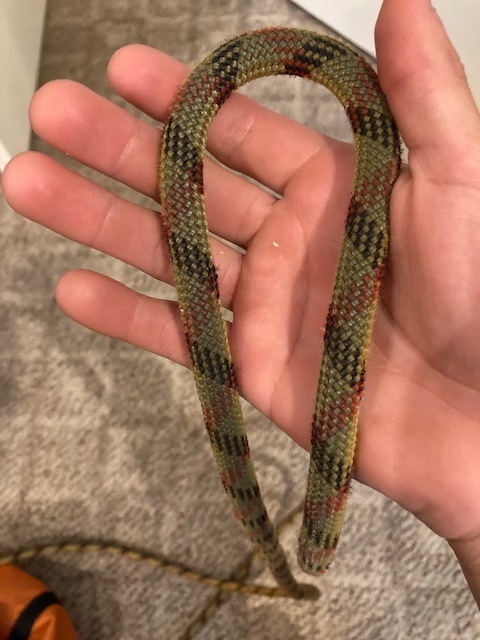 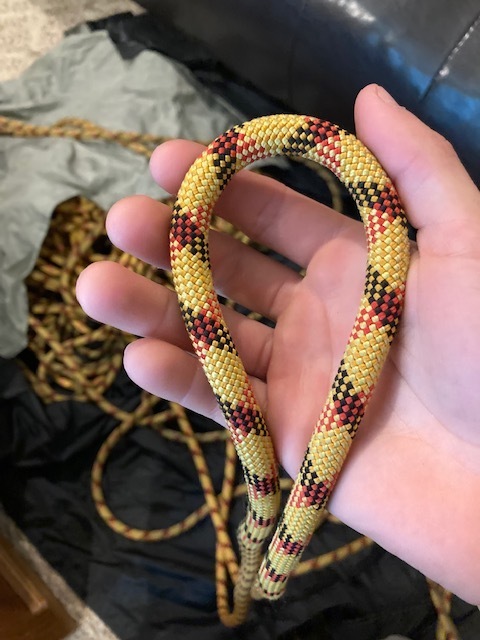 This spot is about a 1ft away from where the black streak ends. |
|
|
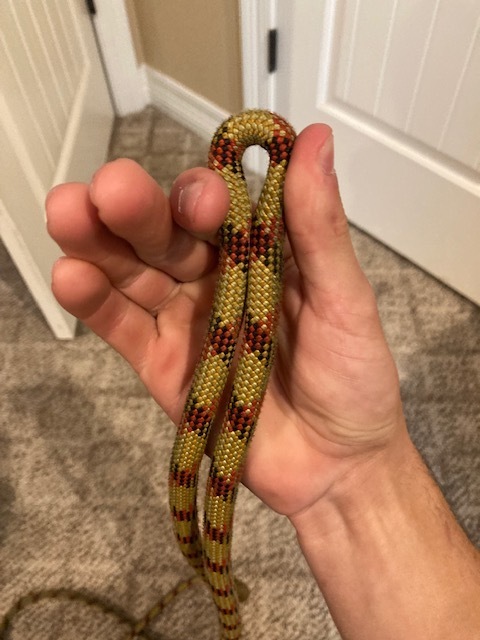 This is me pinching the rope where the streak takes place. 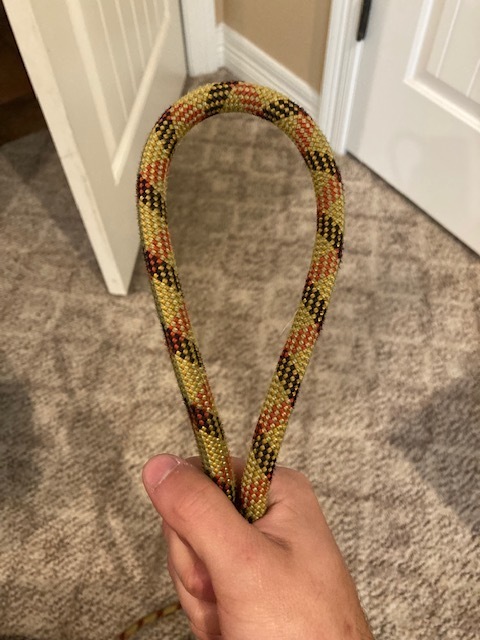 Making a bight where the streak takes place. |

|
The black streak is aluminum oxide. |
|
|
As stated above, the black streak is aluminum oxide caused by the rope running through gear. This is completely normal. Would definitely whip on that rope. Good on you for asking. Have fun on your outing. |
|
|
So although its from 2013 it should still in theory be safe? |
|
|
With the obvious caveat that looking at a photo of a small section of the rope on the internet is not a sufficient examination, that rope looks fine to me. Less than 10 years old, stored properly, no visible core (white nylon), no very soft spots, I say you are good to go. If you do cut down the rope you need to remember and communicate how long the rope is now, but I would not cut the dirty part off. And always tie a knot in the bottom end of the rope! |
|
|
Diego Bwrote: In my opinion, a rope that has barely been used and stored properly is fine for climbing, even if it is eight years old. That being said, if you have any qualms about using it, don't. According to your post, you have three other ropes that you can use and about ten people in your group. Three ropes should be plenty for your purposes. |
|
|
Ropes lose about 5% of their strength per year, even when in storage. That's why rope manufacturers warn you not to use a rope after 10 years, since a 10 year-old rope is only half as strong as new. A 20 year-old rope is no stronger than a shoelace. The black stuff is really bad and you should cut it off. Likewise, if any gets on your hands after climbing you should cut your hands off. Seriously, unused ropes that are stored properly don't degrade with age at any rate that matters in a human lifespan. Rope manufacturer's guidance about 10 years or whatever is a made up number because they don't want the liability of saying their ropes last forever. And the black stuff is the dust from carabiners as they wear down. Climb on and have fun. |

|
Your rope is used, so this is not totally applicable - Black Diamond gear lab did testing of old gear, here is link - https://www.blackdiamondequipment.com/en_US/stories/experience-story-qc-lab-old-vs-new-gear-testing/ Here is snippet - Observations, Thoughts and Comments Once again, with pretty much only one data point in each test, it would appear that the 20-year-old new rope performs pretty much as if it was made yesterday. These were the same results I had a few years ago when testing an old, but unused rope that had been stored properly. The old, unused rope pretty much mirrored the results of the new rope:
It’s actually unbelievable how close the results were—but we do need to remember that we’re talking about only one data point, and we’re not comparing exact samples here—the old rope is 10.5mm, and the new one is 10.2mm from a different manufacturer with likely different construction. It’s important to think of this information as directional—to give some insight. I was doing some digging on the internet about the behavior of old, but unused ropes and found this from the Tendon website: In the process of rope production, the fibres are mechanically doubled, twisted and braided in several stages. In this way the fibres finally attain a condition of mechanically induced stress. A long-term storage leads to retardation and relaxation. This means that stress in macromolecules is “relieving”. This phenomenon is not harmful, on the contrary it is connected with an improvement of dynamic properties. Research works showed that the results of tests of dynamic performance of ropes that had been (optimally) stored for several years were often better than values measured immediately after production. Polyamide also does not contain additives and softeners like, for example, PVC that could diffuse out. This is the reason why no embrittlement occurs. So should you go climbing on an old, but un-used piece of gear? Well, ultimately it’s up to you. Chances are technology has changed and there is better gear on the market. In this case, this rope is considered super fat by modern standards and most folks wouldn’t be psyched to carry a big old cord like that to the crag, much less have a belay device that worked properly with it. Plus, as we all know, climbing is a serious game, so if you’re ever in doubt about your rope, or any piece of gear—it’s probably best to retire it. |
|
|
If you cut off a section of a climbing rope, there should be a colored strand or something to indicate the year it was manufactured in. You would have to contact Beal on what they add to the core. |
|
|
soft cruxwrote: At 5% per year, it would be about 60% (40% reduction) of new after 10 year and 36% of new (64% reduction) after 20 ;) Peoeple always claim that ropes don’t lose strength over time when stored properly, which is probably mostly true. But strength isn’t necessary the most relevant measure here, how does time affect elongation and impact force? Probably negligible too, but I’ve not seen those numbers. |
|
|
Yury wrote: Read his whole post, he was just joking. |
|
|
Is the long black streak in the middle of the rope? Could it be a middle mark? Your rope is fine to use especially if you are just top roping but I wouldn’t hesitate to lead on it. Ropes are extremely robust. If nylon degraded so much over time car manufacturers would be recalling their cars all the time to replace seatbelts that are subjected to sun and high temps all the time. |
|
|
Looks fine. Ropes get dirty -- likely the black is aluminum oxide (from all the aluminum carabiners, etc), though could be other black dirt. The black streak doesn't worry me. Of course, YGD. But not because of that rope being old. |
|
|
What matters here is not whether they are objectively safe or not, what matters is that the rope is from (and therefore legally connected to) an institutional setting. In order to prevent liability in a lawsuit in the low low low low low chance that anything was to go wrong with this rope, you must follow the manufacturer's recommendations for use, storage and retirement of softgood materials used in climbing. Climbing manufacturers give a ridiculously short "lifespan" for their soft goods and a recreational climber can pretty much ignore these recommendations, but an institutional setting cannot. Any lawyer worth their license can win a civil damages case against the institution that doesn't follow the exact manufacturers recommendations which would lead to the end of climbing as an approved sport for the university. Keep in mind that the lifespan starts at the manufacture date of the rope, not the last time used (with the 5 year storage caveat given below). Thus, if this rope was first purchased and used in 2013 you're good to go (though the line "the slightest doubt" seen below, would indicate that one would want to delete this thread as it can be used to show doubt. From the Beal Site: https://sport.beal-planet.com/en/index.php?controller=attachment&id_attachment=6930
FYI: I used to run a climbing program at a summer camp (that was owned by a litigation lawyer) for a decade and have dealt with all of the insurance ridiculousness that is required for an institutional setting. |
|
|
soft cruxwrote: I know, I know. Data is detrimental to discussion, but I'll add some data sources on the aging of ropes anyhow: http://othes.univie.ac.at/43361/ |
|
|
Yury wrote: Why is it that nobody ever asks that question of the rope manufacturers? There is no compelling data that says a 10 year-old rope is materially any different from a new one. In fact there is some data (cited in this thread) that shows even a 20 year-old rope is just fine. The "don't use a rope after X years" rule is not determined by data. It's a made up number. We are accustomed to things having an expiration date, so the gear companies give us one. And then the insurance companies have to use the manufacturer's recommendation and the institutions have to abide by the insurance company's rules and the REI employee that finds an old rope in the stockroom has to chuck it in the trash. |
|
|
soft cruxwrote: All true of course. And all meaningless when a lawyer is going after the deep pockets of a university in some BS lawsuit. |
|
|
dave custerwrote: "predictions at 21 °C. At this temperature, we estimate that a tensile strength loss of 50% takes on the order of 70 years." |
|
|
amariuswrote: Thanks for posting real data. |


