|
|
Sharp End
·
Feb 15, 2021
·
Scotland
· Joined Feb 2021
· Points: 0
|
|
|
Nate A
·
Feb 15, 2021
·
SW WA
· Joined Aug 2018
· Points: 0
I like that’s there’s a flow chart in paragraph form that lets you know whether or not to use the flow chart.
|
|
|
Marty C
·
Feb 15, 2021
·
Herndon, VA
· Joined Aug 2008
· Points: 70
Andy Tyson wrote a Self Rescue book (2006) that contained two flow charts for self rescue similar to what you have done. For completeness, you might want to look at them for ideas.
|
|
|
Ben Everman
·
Feb 15, 2021
·
Unknown Hometown
· Joined Dec 2018
· Points: 0
This looks like an amazing resource. Commenting to follow
|
|
|
Sharp End
·
Feb 15, 2021
·
Scotland
· Joined Feb 2021
· Points: 0
Marty Cwrote:Andy Tyson wrote a Self Rescue book (2006) that contained two flow charts for self rescue similar to what you have done. For completeness, you might want to look at them for ideas. Thanks. I'll check it out!
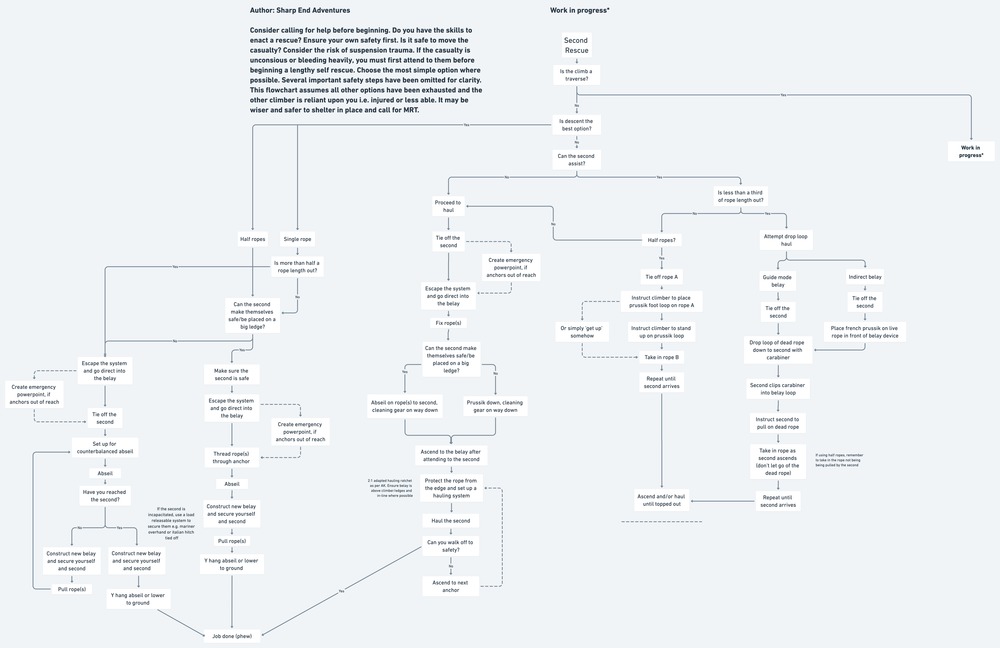
I've made quite a few changes to the flowchart so the photos are no longer accurate, but I think it's nearing perfection. At least, I've stopped obsessing about it, which must mean I'm near the end!
|
|
|
Gerson R
·
Feb 15, 2021
·
Las Vegas
· Joined Oct 2017
· Points: 1
it's a little blurry missed the links
|
|
|
Fail Falling
·
Feb 15, 2021
·
@failfalling - Oakland, Ca
· Joined Jan 2007
· Points: 1,021
|
|
|
Rasputin NLN
·
Feb 15, 2021
·
fuckin Hawaii
· Joined Aug 2018
· Points: 0
"tie backup knot to solid piece of gear, untie original tie-in and thread rope through piece". Wouldn't it make more sense to just clip the rope through a carabiner, or is there something I'm misunderstanding?
|
|
|
Short Fall Sean
·
Feb 15, 2021
·
Bishop, CA
· Joined Sep 2012
· Points: 7
It's cool that you made this, but heaven forbid if someone actually needs to consult a reference like this.
|
|
|
Short Fall Sean
·
Feb 15, 2021
·
Bishop, CA
· Joined Sep 2012
· Points: 7
I realized that seemed a bit flippant, but what I mean is that the general goals and options in a rescue scenario should probably be common sense. You need to learn the technical skills like how to escape a belay or how to prussik a rope or tandem rappel, but you shouldn't be up there thinking, "Hmmm more than half the rope is out, does that mean I can lower the leader back to me?"
|
|
|
T Lego
·
Feb 16, 2021
·
Asheville, NC
· Joined Apr 2020
· Points: 21
Short Fall Seanwrote:I realized that seemed a bit flippant, but what I mean is that the general goals and options in a rescue scenario should probably be common sense. You need to learn the technical skills like how to escape a belay or how to prussik a rope or tandem rappel, but you shouldn't be up there thinking, "Hmmm more than half the rope is out, does that mean I can lower the leader back to me?" In the teaching world, stuff like this would be considered a supplement. You study it and check yourself on it, or refer back to it. I don't think his aim is to have people use it in the field during a real rescue.
|
|
|
Fail Falling
·
Feb 16, 2021
·
@failfalling - Oakland, Ca
· Joined Jan 2007
· Points: 1,021
Short Fall Seanwrote:I realized that seemed a bit flippant, but what I mean is that the general goals and options in a rescue scenario should probably be common sense. You need to learn the technical skills like how to escape a belay or how to prussik a rope or tandem rappel, but you shouldn't be up there thinking, "Hmmm more than half the rope is out, does that mean I can lower the leader back to me?" I'm pretty sure that if I'm incapacitated while on lead, I want my second up there thinking "hmmmm more than half the rope is out..." BEFORE trying to lower me.
|
|
|
Short Fall Sean
·
Feb 16, 2021
·
Bishop, CA
· Joined Sep 2012
· Points: 7
Fail Fallingwrote: I'm pretty sure that if I'm incapacitated while on lead, I want my second up there thinking "hmmmm more than half the rope is out..." BEFORE trying to lower me. Yeah for sure, but what I mean is that I'd hope to be climbing with someone who doesn't need to consult a flow chart to know things like that and who excels at thinking on his feet.
|
|
|
Fail Falling
·
Feb 16, 2021
·
@failfalling - Oakland, Ca
· Joined Jan 2007
· Points: 1,021
Short Fall Seanwrote: Yeah for sure, but what I mean is that I'd hope to be climbing with someone who doesn't need to consult a flow chart to know things like that and who excels at thinking on his feet. I get that. But at least in my experience, work flow documents are pre-action study guides or autopsy analysis tools rather than "use this when the issue arises" documents. Or to put it another way: I def don't want to be climbing with a partner that brings along an entire self rescue book with the intent to refer to it once I'm hanging lifeless at the end of the rope, but, I'd hope that my partner owns the book and has read through it prior to the climb. In the same vein, I'm not going to eschew the existence of self rescue books based upon the outlier possibility of someone referring to it on a route during an emergency since the assumption is that they're used for understanding prior to or after the event.
|
|
|
Doug Haller
·
Feb 16, 2021
·
Boulder, CO
· Joined Jun 2005
· Points: 604
nice work. thanks for posting. I doubt most people think about the various scenarios and options.
|
|
|
Sharp End
·
Feb 17, 2021
·
Scotland
· Joined Feb 2021
· Points: 0
Rasputin NLNwrote:"tie backup knot to solid piece of gear, untie original tie-in and thread rope through piece". Wouldn't it make more sense to just clip the rope through a carabiner, or is there something I'm misunderstanding? I assume you meant:
'Can the leader be lowered to a solid piece (in line)?' - 'Lower leader to solid piece' - 'Leader goes direct into solid piece and ties backup knot in rope to belay loop' - 'Leader unties original knot, pulls rope down, threads piece and reties onto rope.' etc.
If so, after being lowered to a solid piece, the reason for tying the back up knot (will try to distinguish up strand to down strand) to your belay loop is so that when you pull the rope down you won't lose it completely and because the rope is now going above you through the top piece and back down to the belayer, the only way you can pull it down is by untying. You couldn't simply clip you rope, because that won't achieve anything. I did change 'thread' to 'clip' on 'Leader unties original knot, pulls down-strand rope, clips piece and reties onto end of rope' because at that point you could just clip it. If that is what you meant, then thanks for pointing it out.
https://people.bath.ac.uk/dac33/high/13SelfRescueSenarios2.htm#traversesetc section 8 on this page has a simple cartoon explaining the process and it's where I pulled a lot of the methods (all credit to David Coley and Andy Kirkpatrick).
Unfortunately, I can only post once per day so: I realised that seemed a bit flippant, but what I mean is that the general goals and options in a rescue scenario should probably be common sense. You need to learn the technical skills like how to escape a belay or how to prussik a rope or tandem rappel, but you shouldn't be up there thinking, "Hmmm more than half the rope is out, does that mean I can lower the leader back to me?"
Can't disagree more. Unless you're a cyborg with the ability to compute the myriad of possible choices and choose the right one within milliseconds, you're obviously going to be doing the kind of thing you're railing against. The general goal is straightforward - to get off the cliff safely - but the options (see flowchart) are multiple and complex. I'd bet most climbers at best, verge on incompetence when it comes to self rescue ability with a handful of climbers being semi-decent (maybe me). I suspect very few, only the most experienced and elite (definitely not me), climbers would be able to complete all the steps in the flow chart.
I will the flowchart to practice, to think through theoretical problems and maybe even one day I'll refer to it during an actual rescue (and if my second doesn't like it, then they'll have a terrible accident). Paramedics and doctors aren't expected to remember all the life saving protocols they use and neither are climbers - we're only human and we forget things. Even in a hospital, you'll see in every ward a poster that explains the most basic life saving algorithm used during a cardiac arrest...
What I recommend is that everyone have a base knowledge and use this like a supplement, like T Lego said. Please do have a good read and suggest edits. Let's make it perfect-ish.
|