
 Continue with onX Maps
 Sign in with Facebook








How old is this piton?


|
I came across a rusty ring piton on a Wiessner route called Unnamed, which I understand isn't climbed much. It looked older than other rusty pitons I've come across. Any guesses how old it is? Is it possible that Wiessner himself might have placed it? 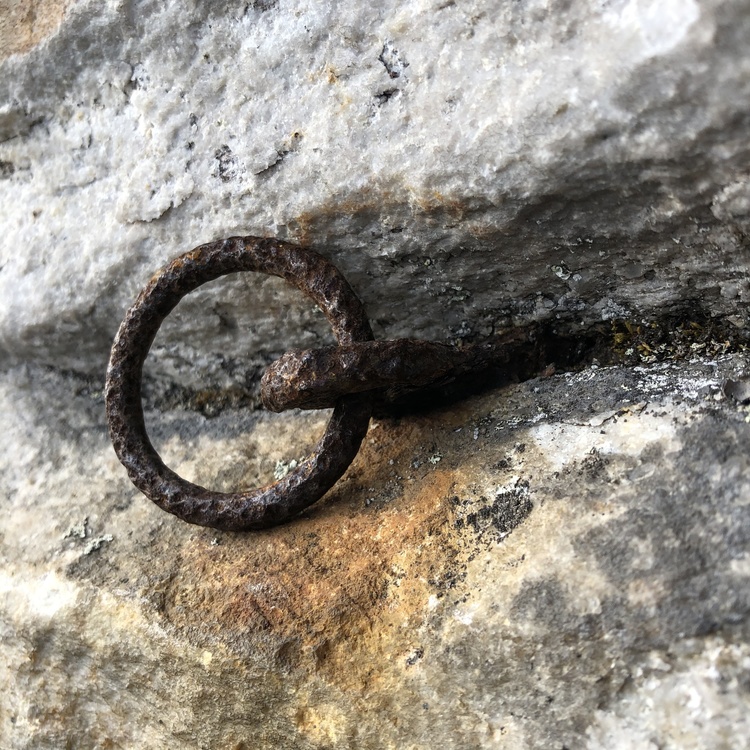 |
|
|
That (FW placed it) would be my guess. |
|
|
It's a ww11 era army surplus pin possibly placed by fritz. |
|
|
Old as fuck |
|
|
yeah but did you clip it or not? |
|
|
Mike. that's a great sentiment but its more likely fritz did the pitch sans gear and only used a single pin for belay. If he did place running protection the 2nd would have cleaned it if at all [possible. the concept of equipping a route for other climbers was not a thing back then. leaving pins was similar to leaving booty. Something that was considered a lack of skill on the followers part or perhaps blamed on the leader for over driving the pin. So yes its possible that fritz left the pin but more likely the pin came from someone else in the decades that the route existed in the piton era. Army surplus WW11 era pins were still readily available in the early 80s when I started climbing so they would have been very common in the 50s and 60s |
|
|
Nick Goldsmithwrote: Actually Nick part of that is not accurate. The vast majority of the pins used by Fritz and his cohorts in the 30's and 40's were soft iron and very difficult to remove. They were typically left behind - not necessarily for the benefit of future repeaters but just for efficiencies sake. That's one of many reasons why Fritz and other used pins as sparingly as possible. It wasn't until the late 60's when Chouinard perfected the mass production of Chromoly (steel) pins that the ethics if removal and leave no trace became important. Of course that back fired pretty quickly with the resulting pin scars although the concept of LNT as opposed to opening/developing/equipping a route still has some merit. |

|
Surface rust isn’t rot, whip it |
|
|
Actually also not factually correct. climbers have always been cheap and pins expensive (relative) You absolutely can re use soft iron pins. I have done it numerous times and climbers routinely did so before Chiounards pins came along. They do wear out faster and get mangled and sometimes need to be hammered straight after use but it was certainly not a one use item. The times that I have found old pins on Weisner routes I liked to think they were original but also well aware that they likely came from subsequent ascents. From reading fritz's accounts of his climbs it seems that his sparse use of pitons was certainly a style/ego decision. He expressed regret when having to resort to a pin when he thought he could have done the pitch without it. No different than how we feel when we sew something up and feel our egos bruised for not climbing to the standard that we feel we should be able to. If your statement that soft iron pins were not re usable was correct these routes would be absolutely peppered with fixed pins because most folks needed and placed more pins than Fritz or Hans would have placed. So yes it certainly could be an Original Weisner pin but it could also have been placed by some college kid in 1965. Still a cool find regardless. |
|
|
Nick Goldsmithwrote: Not saying that it was/is impossible to reuse them. Just that on average they are more difficult to remove (then hard steel) and on average or more likely to get mangled in the process. Some times you get lucky. Also realize that BITD once a pin was placed there was often little hesitation to using it for some sort of aid. So that also contributed to lead to a reluctance to place it in the first place. There weren't that many (relatively) climbers running around repeating routes and even fewer that weren't financially well enough off that the cost of pitons was a significant factor. Post WW2 a lot of things changed. I really doubt that there was a strong ethic to remove them because they had somehow marred the route and that it had to be restored to its pristine state. but maybe remove them because you might need them on the next pitch(es). |
|
|
Absolutly. cleaning pins was almost certainly done out of necessity not ethics. the clean climbing revolution was not complete in the north east untill about 1972 but even then hammers were still carried for a few more years. that's a lot of opportunity for a cheap army surplus pin to be fixed post FA on most of those Wiesner routes. |
|
|
Back to Phills OP. thats a wicked old pin. what is the date of the FA? certainly it could be Weisner pin but also just as likly somone else placed it sometime prior to 1972... just my opinion.. |
|
|
Nick Goldsmithwrote: Nick, the first ascent was 1942, according to the Williams guidebook. |
|
|
So that would indicate that this climb existed for 30 years before the piton era officially ended and some folks carried hammers for a few more years after that. Any way you look at it that pin has some cool history.. I unearthed this one under about 4 inches of dirt and vegetation while new routing this summer. its about 10ft off the ground on what ended up being a 300+ ft 5.10. I suspect it either went straight up a severely vegetated line or was perhaps from an ice venture? either way we traversed accross the spot I found this and then launched straight up. didn't see any evidence of passage up higher? 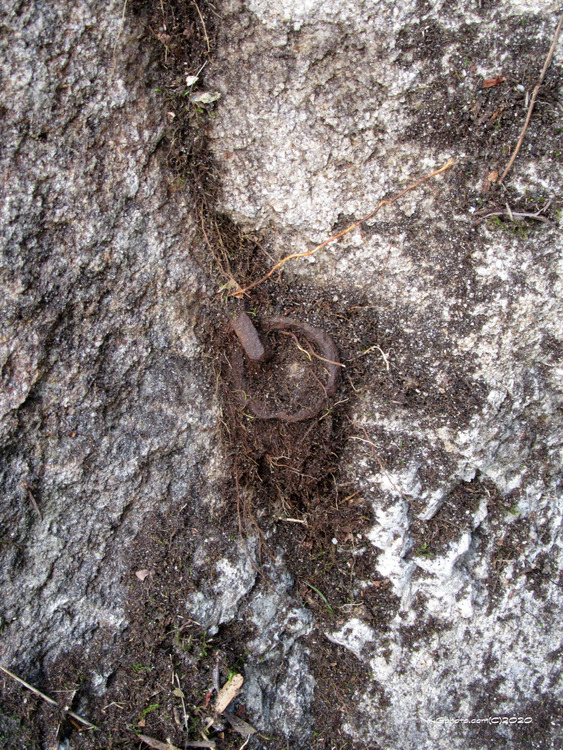 |
|
|
Relevant Q - a lot of the pins that entered the recreational climbing world after WW2 were military surplus. Did the army produce/use ring pitons? At one point years ago I had quite a few military pins, but I don't recall any of them being this sort of ring pin. There was one type, a 3/4 inch angle piton about 8-9 inches long (!), but I doubt those saw much use in the field, and it's not at all like OP's photo. |
|
|
I have several KBs with a ring that I have cleaned over the years. not sure the origin? |
|
|
I think Arizona climber Marty Karabin has a 'piton museum' so he might be a good person to ask, also Steve Grossman in Seattle. Both used to post regularly on Supertopo, but I'm not sure how to contact them currently. I do think the Army produced ring pitons during WW 2, but am not certain. It surely can be one of Fritz's. As Eric posted above, the ethic in the Gunks in the '50s and much of the 60s was to leave pitons in place ( this was in contrast to Yosemite, especially on the longer climbs, where they were routinely removed for use higher), but I don't know if this was true in the '30s and 40s. |
|
|
if you look closely you can faintly make out the signature of the manufacturer- one Paul Revere of Boston, Massachusetts |
|
|
That is a weisenkrausen, used for assessing the weight of meat. -NHFScarlett |
|
|
Gunkiemikewrote: The Army definitely produced what were called "Army Wafers," a short thin-bladed piton with a ring, the type in the photos in this thread. I think they would have had to produce a ring 3/4" angle too, but if they did they were in short supply on the surplus market and anyway indistinguishable from their European counterparts. The wafers, on the other hand, were unique. |
|
|
Those pins could of been made by Stubai. In the mid 60's I bought quite a few soft iron pins in Boston from the Asa Osborne store, near Park Street. There were few places in Massachusetts to buy gear. I still have a few steel oval biners made by Stubai. I remember placing pins like this in the Bugaboos, on a few 1st ascents in 1966, and in my opinion they don't necessarily date back to the WW2 era. |


