Mountain Project Logo

Adjusting the master point height on a quad anchor

Original Post
Alex J · · Washington DC · Joined Apr 2018 · Points: 0

Hi, I'm going on a sport multipitch trip soon and was practicing with my partners so we have our system dialed in. We expect to mostly use quads as anchors since all the anchors on the climb are bolted. As we were practicing I realized i don't know how to adjust the height of a quad if the master point ends up too low for comfort. As far as I see it, the options are:

- untie cordelette and make a pre-equalized V anchor, whose height is easily adjustable
- throw an overhand above the limiter knots in the quad to eat up some rope
- suffer with a slightly lower than optimal master point

Thoughts? Is there a more efficient way to adjust the master point height?

Alexander Stathis · · Chattanooga, TN · Joined Jan 2016 · Points: 657

Not really an answer to your question, but:

If it's sport multipitch you can just use draws with rope carabiner gates facing outwards, like a normal setup at the top of a single pitch route. I'll often clove into a draw on one bolt and belay the follower off of two draws by clipping the locker through both quickdraws. Or you can belay off your harness and redirect through both quickdraws.

Nick Sweeney · · Spokane, WA · Joined Jun 2013 · Points: 1,019
A J wrote:- suffer with a slightly lower than optimal master point
stolo · · Lake Norman, NC · Joined Sep 2016 · Points: 214

Alex you should be attached to both bolts...not just one.

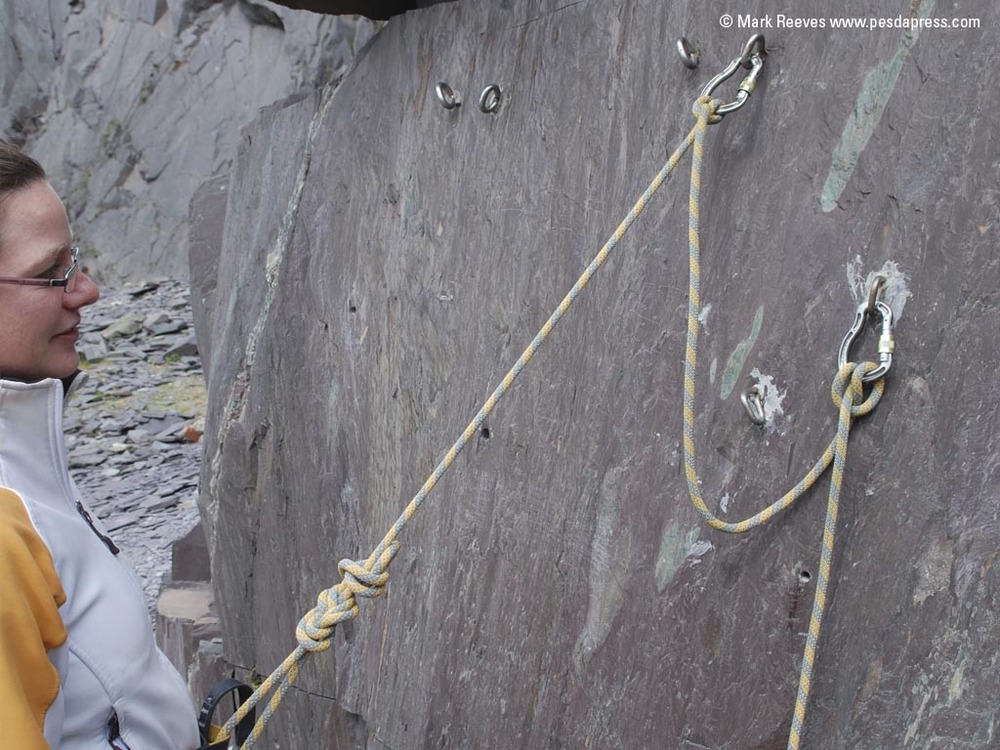
AJ if you are swapping leads then using the the rope for the anchor will be the fastest to build and adjust, clove hitch rope to one bolt, leave enough slack, clove hitch to next, tie masterpoint in bite, belay from there.

Also if it is a bolted sport route then all anchors will probably be more or less the same, and the same pretied quad will work for all belays. Then adjust yourself with your clove hitched rope to quad.

Andrew Rice · · Los Angeles, CA · Joined Jan 2016 · Points: 11

Make sure your quad isn't tied too long. Bolt anchors tend to be relatively similar in the distance between bolts. If it's REALLY a problem then clove the legs of your quad to the carabiners to just eat up some slack. 

a beach · · northeast · Joined Jun 2013 · Points: 518

you can always fold your "quad" one more time to make it six strands instead of four. I've done this if the bolts are close together.  If your swapping leads using the rope is also infinitely adjustable and bomber.

Danny · · Seattle · Joined Sep 2015 · Points: 135

if you're swinging leads between bolted anchors, the "Super 8" rope anchor is my preferred method: http://eveningsends.com/best-multi-pitch-climbing-knot-youve-never-heard/

since you are the type to prepare for a trip, add this to your toolbox so you can try it out there. since i learned it i stopped carrying the cordelette. 

Jeffrey Constine · · Los Angeles, CA · Joined May 2009 · Points: 674

Just use the rope lol

tradvlad · · SLC, UT · Joined Oct 2012 · Points: 5

Sounds like you have some good ideas. I second what beach said about using 6 strands instead of 4 (hex anchor?).
Another option would be to construct an offset quad, where one shelf sits higher then the other shelf.

Nick Drake · · Kent, WA · Joined Jan 2015 · Points: 651
stolo wrote: Alex you should be attached to both bolts...not just one.

Meh not really. The bolts should be linked, but there is nothing wrong with a clove into just one of the bolts to anchor you. People way overthink this, there is absolutely no need to be equalized into both pieces when they are good bolts that could take a 40 footer off of confidently. 

If the bolt is so questionable that it can't take body weight you've got other problems and should be setting up a rap, not belaying a follower. If there is hard sketch climbing right off the anchor climb up to get a first piece/first bolt of the next pitch clipped and come back down to the belay. 

However if you aren't sure of your ability to evaluate hardware accurately yet, by all means default to overkill. 

Alexander Stathis · · Chattanooga, TN · Joined Jan 2016 · Points: 657
Nick Drake wrote:

Meh not really. The bolts should be linked, but there is nothing wrong with a clove into just one of the bolts to anchor you. People way overthink this, there is absolutely no need to be equalized into both pieces when they are good bolts that could take a 40 footer off of confidently. 

If the bolt is so questionable that it can't take body weight you've got other problems and should be setting up a rap, not belaying a follower. If there is hard sketch climbing right off the anchor climb up to get a first piece/first bolt of the next pitch clipped and come back down to the belay. 

However if you aren't sure of your ability to evaluate hardware accurately yet, by all means default to overkill. 

Yes, I agree. People whip onto single bolts all the time without thinking even when the bolt's failure would result in a serious accident. But hang bodyweight on a single bolt and you're gonna die. 


Obviously if the bolt(s) are sketchy you should not just be on one, but this isn't the case often for me. 

Harumpfster Boondoggle · · Between yesterday and today. · Joined Apr 2018 · Points: 148
Nick Drake wrote:

Meh not really. The bolts should be linked, but there is nothing wrong with a clove into just one of the bolts to anchor you. People way overthink this, there is absolutely no need to be equalized into both pieces when they are good bolts that could take a 40 footer off of confidently. 

If the bolt is so questionable that it can't take body weight you've got other problems and should be setting up a rap, not belaying a follower. If there is hard sketch climbing right off the anchor climb up to get a first piece/first bolt of the next pitch clipped and come back down to the belay. 

However if you aren't sure of your ability to evaluate hardware accurately yet, by all means default to overkill. 

You should be physically tied into two separate points (both bolts) whenever possible (regardless of their linking) at all times to safely belay, imo. This is elementary redundancy that greatly reduces the chance of a significant oversight or single failure.

stolo · · Lake Norman, NC · Joined Sep 2016 · Points: 214

Why would you not use both bolts if they are there, that is dumb. Yea people whip on bolts, there is also another one not too far below. What if rock fall takes out your connection to one bolt?

Buck Rio · · MN · Joined Jul 2015 · Points: 16
stolo wrote: Why would you not use both bolts if they are there, that is dumb. Yea people whip on bolts, there is also another one not too far below. What if rock fall takes out your connection to one bolt?

You are connected to both bolts, they are not equalized.  Take rope coming from waist and clove to one bolt. hang on bolt. Take the running side of rope, with some slack, and clove to other bolt. Now take the slack between the bolts and tie an overhand and use as masterpoint.  You are still into both bolts, but not equally, in fact you are only weighting one of the bolts.

stolo · · Lake Norman, NC · Joined Sep 2016 · Points: 214
Buck Rio wrote:

You are connected to both bolts, they are not equalized.  Take rope coming from waist and clove to one bolt. hang on bolt. Take the running side of rope, with some slack, and clove to other bolt. Now take the slack between the bolts and tie an overhand and use as masterpoint.  You are still into both bolts, but not equally, in fact you are only weighting one of the bolts.

I interpreted the example earlier as using a quickdraw to attach to one bolt and use two more quickdraws for the belay. Yes, I agree with using the rope as you describe and recommended to op, works great and a rope is more durable than a sling. 

Nick Drake · · Kent, WA · Joined Jan 2015 · Points: 651

Think about this one a bit.

Scenario A: I have a premade quad, I clip to two bolts, put a locker on 2-3 strands and then clove into it.

Scenario B: I clove into the bottom of a chain on one bolt and clip a quickdraw between the two bolts (high bolt and lower on chain, just to satisfy limiting extension).

In either scenario I only actually have one connection to the anchor, my rope and a locker. The only difference here is how I have linked the bolts. Both methods use nylon or dyneema between the bolts, one just has a lot more faff to it. If you're really concerned about being tied into TWO points than you need to start climbing with half ropes and go in with both of them. This is beyond overkill. 

nathanael · · San Diego · Joined May 2011 · Points: 525

Clove hitch into one bolt, pull a little slack up, clove hitch into the 2nd bolt. Clip your Grigri onto the same biner as the 2nd clove. Belay up.
Or PAS into one bolt, quick draw connecting the two bolts, and grigri into the 2nd bolt.

Or put up your quad, PAS into the master point, and put your grigri direct into one of the bolts.

All this to say, if the bolts are bomber then it's ok to put your belay device (and/or your personal tether) direct into one of the bolts, and then connect the two bolts (in any number of ways) for redundancy.

Alex J · · Washington DC · Joined Apr 2018 · Points: 0

Thanks everyone for your responses. We will mostly not be swinging leads which is why we aren’t using the rope to anchor. I like the tripled up (6 stranded) quad idea.

I should add, i dont expect this to come up on the climb. But it came up during practice since the practice bolts at the gym were set low and it got me curious

tradvlad wrote: Another option would be to construct an offset quad, where one shelf sits higher then the other shelf.

I am not sure what you mean by offset quad, could you expand on this? Thanks.

Steven Claggett · · Anchorage, AK · Joined Dec 2016 · Points: 0
stolo wrote: Why would you not use both bolts if they are there, that is dumb. Yea people whip on bolts, there is also another one not too far below. What if rock fall takes out your connection to one bolt?

This is just getting crazy. 1) I read accident reports consistently and I have never once read a report of rock taking out a connection to a bolt because that the type of one in a million chance that, if you are climbing at all, you kinda just have to accept, particularly because any rock fall large enough to take out a bolt is probably going to hit you and you're going to die anyway. You mitigate all reasonable risks, and the risks that are just insanely small, you have to accept. 2) Keep yourself in the system (use the rope for the anchor or clove directly into the same biner your anchor is in) even if the bolt rips out, you are still connected to the other bolt. Connecting to both bolts separately creates a cluster fuck of ropes, biners etc at the anchor. THAT is the type of thing that gets people killed. Connecting to one bolt, keeping a closed system, and trusting that something that can take a giant whipper can take bodyweight keeps your systems neat, organized and simple, reducing the chances of errors.

Steven Claggett · · Anchorage, AK · Joined Dec 2016 · Points: 0
Buck Rio wrote:

You are connected to both bolts, they are not equalized.  Take rope coming from waist and clove to one bolt. hang on bolt. Take the running side of rope, with some slack, and clove to other bolt. Now take the slack between the bolts and tie an overhand and use as masterpoint.  You are still into both bolts, but not equally, in fact you are only weighting one of the bolts.

Bingo, beat me to it.

Paul Hutton · · Nephi, UT · Joined Mar 2012 · Points: 740
stolo wrote: Alex you should be attached to both bolts...not just one.

AJ if you are swapping leads then using the the rope for the anchor will be the fastest to build and adjust, clove hitch rope to one bolt, leave enough slack, clove hitch to next, tie masterpoint in bite, belay from there.

Also if it is a bolted sport route then all anchors will probably be more or less the same, and the same pretied quad will work for all belays. Then adjust yourself with your clove hitched rope to quad.

I did this on the 1900ft bolted route Squawstruck in Utah. Worked great. Easy, light, fast. Two lockers (locker - non locker; two non - lockers) is your belay station. 

Guideline #1: Don't be a jerk.

Climbing Gear Discussion
Post a Reply to "Adjusting the master point height on a quad anchor"

Log In to Reply
Welcome

Join the Community! It's FREE

Already have an account? Login to close this notice.