
 Continue with onX Maps
 Sign in with Facebook








Extended Rappel Variation


|
|
I'll typically extend a rappel in order and use an autoblock clipped to my leg loop when climbing in areas with high rock fall potential or when I'll be cleaning a lot of gear.      |
|
|
Huh? Whats the original problem exactly? |
|
|
This makes shifting around at a hanging belay easier and adds redundancies. It be comes really efficient when you're using a sliding x as your anchor to begin with. |
|
|
Well; I like it enough that I'm going to have to mess around with it a bit. Typically when I have multiple rappels to the ground I run a double length sling through my tie-in points (or belay loop) & tie a overhand leaving me with 2 loops (one long, one short). The Atc biner goes through both loops & I use the longer loop to clip the anchor. With my setup you have to clip to a single anchor point (usually a sliding X made with a extenda-draw-both climbers use this). I could see your way being better if there are chains/multiple clip in points on the bolts. |
|
|
Extending the device is nice. |
|
|
Give it a try and let me know what you think. This was really inspired after climbing in el potrero and literally spending hours rappelling in the fashion which Kirk described. |
|
|
Several things: |

|
Reiterating to some of what has been said. If you are going to extend your rap device do not do it by girth hitching your belay loop but use the harnesss tie in points. Do not auto block to the leg loop but do use the belay loop. As far as the specific technique here I think it is a tradeoff - complicates the rapping setup but helps with the anchoring. |

|
@EricE, why girth hitch to the tie-in points as opposed to belay loop? What's the reasoning beyond eliminating a risk link in the chain? |
|
|
@Eric W - the classic argument is that girth hitching your belay loop repeatedly kinks it up and will wear out the loop. Jury is still out on that but you might as well go though the beefier and redundant tie in points. |
|
|
As I understand it, it's not suggested to tie in to your leg loop not from a strength perspective, but if you get knocked out by a falling rock but caught by your autoblock on a leg loop, you will be hanging at an inverted position. |
|
|
yr fine ... |
|
|
In real life I never extend, don't use an autoblock and do girth hitch my belay loop to anchor with. But on the Interwebs we discusss theory 101. |
|
|
Jon H wrote:... but if you get knocked out by a falling rock but caught by your autoblock on a leg loop, you will be hanging at an inverted position. As opposed to plummeting to your death. |
|
|
Eric Engberg wrote:In real life I never extend, don't use an autoblock and do girth hitch my belay loop to anchor with. But on the Interwebs we discusss theory 101. which is useless 101 in this case ... 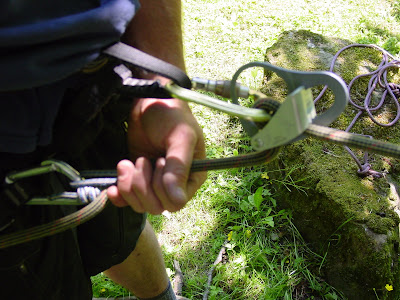 |
|
|
WTF interwebz?! Classic school of back up on rappel is either a prussic above the device, or an autoblock... wait for it... on the damn leg loop! Belay loop hold device... autobloc under device, by your hand... why make it so difficult? |
|
|
Stephen Ackley wrote:@ Eric E and the Engineer - the set up I described requires attaching the auto block to the leg loop because the atc is less extended than your classic set up with a girth hitched 120cm sling and overhand knot. I certainly see the argument about using the belay loop - it is stronger - but the leg loop is more than adequate to hold body weight right? I'd be interested to see if there are any reports of a leg loop failing perhaps when catching a falling climber. As mentioned, the main risk (although greatly reduced by extending) is of a leg loop prusik coming into contact with the belay and releasing if an injured abseiler inverts, which is a reasonable possibility if wearing a pack. |
|
|
Erik W wrote:@EricE, why girth hitch to the tie-in points as opposed to belay loop? What's the reasoning beyond eliminating a risk link in the chain? I've had numerous discussions on this issue with fellow climbers, instructors and guides over the years and never come to a definitive decision. However, there are certain points, most people agree on: |
|
|
Stephen Ackley wrote: the classic argument is that girth hitching your belay loop repeatedly kinks it up and will wear out the loop. Jury is still out on that but you might as well go though the beefier and redundant tie in points. I don't know about it being a classic argument, but I get what you're saying. BD did a test on a handful of belay loops after Skinner's death... interesting results. 75% cut thru = fail @ 2918 lbf. Heavy, heavy abrading = fail @ 4805 lbf. Ex-Engineer wrote: - having any sling girth hitched to your belay loop on a PERMANENT basis could be a really bad idea - fabric on fabric always risks potential wear so both belay loop and sling should be inspected before and after use, but you can't do that properly unless you remove the sling. This is where I am. PAS permanently girth-hitched to the belay loop. Check both very regularly for wear - and you can easily check them by loosening the girth hitch and inspecting all the elements (belay loop & PAS). Been doing it this way since 2004, having gone thru four PAS systems in that time, none of which were retired due to abrasion. |
|
|
Hey Stephen,  |
|
|
Glad you liked the set up Kirk. |


